Italy · One-day route
Rome in a Day
From the empire to dinner
Some links on this page are affiliate links — if you book through them we may earn a commission at no extra cost to you.
Rome is two thousand years of cities stacked on one walkable line, so the day runs in a single direction with no backtracking: ancient Rome first on the earliest timed ticket, the old centre in one northward walk, the Vatican as one afternoon block, and dinner across the river. Two bookings hold the whole day up — the Colosseum's first morning slot and a mid-afternoon Vatican slot — and everything else is walking.
Morning
The Colosseum
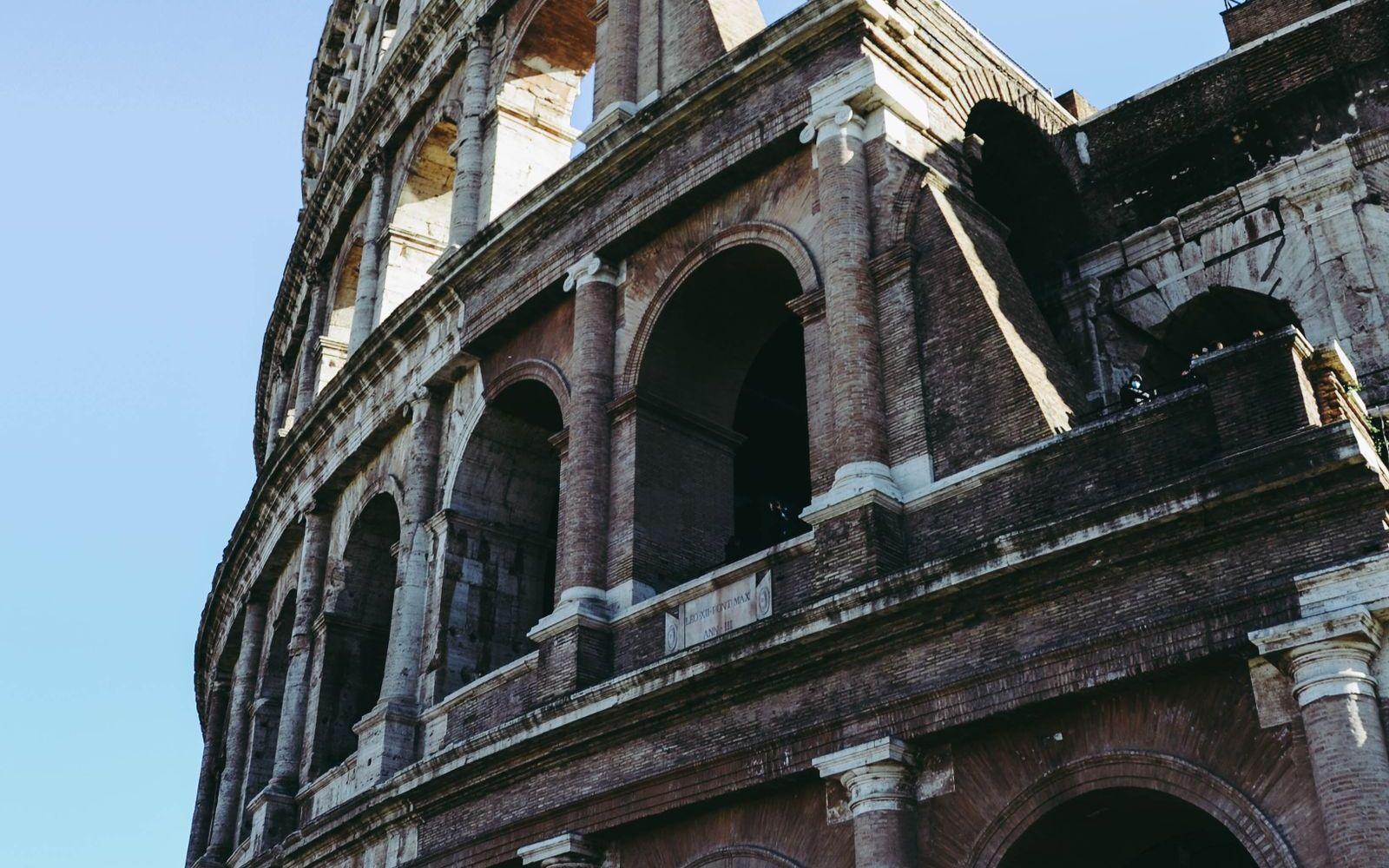
Start where Rome starts, on the first timed slot of the day. The emperor Vespasian began the Colosseum around 70 AD, and his son Titus opened it in 80 AD with a hundred days of games. It held about fifty thousand people — still the largest amphitheatre ever built — and it rose on the drained lake of Nero's palace, a deliberate gift of stolen land back to the public. Inside, the floor is mostly gone, and that's the gift: you look straight down into the hypogeum, the two-storey warren of cages, lifts, and trapdoors that ran the show from below. Every ticket is timed and in your name; the standard 24-hour ticket costs €18 and quietly includes the next stop.
Late morning
The Roman Forum & Palatine Hill
Your Colosseum ticket walks you straight into the Roman Forum — no second booking. This valley was the empire's front office: courts, temples, the Senate house, and the Via Sacra running through it like a main street. Walk it slowly toward the Arch of Titus, raised around 81 AD; inside its vault, Roman soldiers carry off the menorah from the Temple in Jerusalem — a carving so accurate it later became the model for the emblem of the modern state of Israel. Then climb the hill the Forum leans against: tradition says Romulus founded Rome on the Palatine in 753 BC, and the emperors built their palaces here — which is literally where the word “palace” comes from. From the terrace, the Forum spreads out behind you and the long green scoop of the Circus Maximus, the chariot stadium that held a quarter of a million people, opens on the other side.
Midday
The Pantheon
Walk north into the old centre and the portico appears: the Pantheon. The inscription credits Agrippa, from 27 BC — but the building you're looking at is the emperor Hadrian's rebuild, finished around 125 AD, keeping the original name on the front like a dedication plaque. It is the best-preserved major building of ancient Rome, and the reason is simple: in 609 it was consecrated as a church, and it has been in use every day since. Step inside and look up. The dome is a perfect hemisphere — 43.3 metres across, and exactly 43.3 metres from the floor to the opening — and still the largest unreinforced concrete dome in the world. The nine-metre hole at the top, the oculus, is the only window; when it rains, the rain comes in too, and drains away through hidden holes in the floor. Entry is €7, and Raphael is buried here — look for the tomb with the crowds in front of it.
Afternoon
Piazza Navona, the Trevi & the Spanish Steps
The old centre unfolds in short walks. Five minutes west, Piazza Navona — and the shape gives it away: that long oval is the ghost of Domitian's stadium, built in 86 AD for thirty thousand spectators, and the square simply kept the track's outline. In the centre, Bernini's Fountain of the Four Rivers, finished in 1651, holds up an Egyptian obelisk with the Nile, the Ganges, the Danube, and the Río de la Plata — the four corners of the known world. Ten minutes east, the Trevi Fountain: Nicola Salvi designed it, work began in 1732, and it was finished in 1762, fed by an aqueduct from 19 BC that still runs today. Do the ritual properly — back to the water, coin in your right hand, over your left shoulder; around €3,000 lands in the basin every day, and all of it goes to Caritas, the Catholic charity. Ten minutes north, the Spanish Steps climb 135 steps to the church of Trinità dei Monti. They opened in 1725 — and since 2019 they are strictly standing room only.
Late afternoon
The Vatican: Museums, the Sistine Chapel & St Peter's
Afternoon belongs to the Vatican — the second anchor you booked weeks ago. The Vatican Museums are a river, not a lake: the galleries carry you one way, through rooms like the Gallery of Maps, forty panels of Italy painted in the 1580s, all of it flowing toward one small chapel at the end. That chapel is the Sistine. Michelangelo, who insisted he was a sculptor, painted the ceiling between 1508 and 1512 — nine scenes from Genesis, more than three hundred figures — and came back a quarter-century later to cover the altar wall with the Last Judgment, finished in 1541. Photography inside is forbidden and silence is enforced; it is also a working room, where the cardinals gather to elect a pope. From the museums it's a fifteen-minute walk around the Vatican walls to St Peter's Square and the largest church in the world: consecrated in November 1626, which makes 2026 its four-hundredth birthday. Entry is free — the only queue is security — and inside waits Michelangelo's Pietà, carved when he was twenty-four, beneath his dome.
Evening
Across the river to Trastevere
End the day the Roman way: on foot, across the water. Ponte Sant'Angelo gives you the postcard — Bernini's angels, the castle ahead, St Peter's dome behind. Cross the Tiber into Trastevere, the neighbourhood “across the river,” where Rome stops performing and starts living. Its heart is the piazza of Santa Maria: one of the oldest churches in Rome dedicated to the Virgin, founded in the third century and rebuilt in the 1140s, with gold mosaics on its face that catch the last of the light. Find a table in the piazza. Order something with guanciale in it. You have walked from the empire to dinner, and the city did all the work.
Three tips
- Book the two anchors first — the Colosseum's first morning slot and a mid-afternoon Vatican Museums slot. Both are timed-entry, both sell out, and the whole day hangs between them.
- The Vatican Museums are closed on Sundays, except the last Sunday of the month, when entry is free and the crowds are the worst of the month — admire the generosity, go another day.
- Admire the Spanish Steps standing: sitting on them has been banned since 2019, with fines from €250.
Plan it
Booking pieces for this route, in one place.
This route, planned for you automatically
The RoamTheCities app turns days like this into a personal itinerary — tell it your pace, food, and budget, and every stop explains why it fits you. Be first to know when it launches on iOS.
One email when we launch — no spam, and we never share your address. Privacy Policy